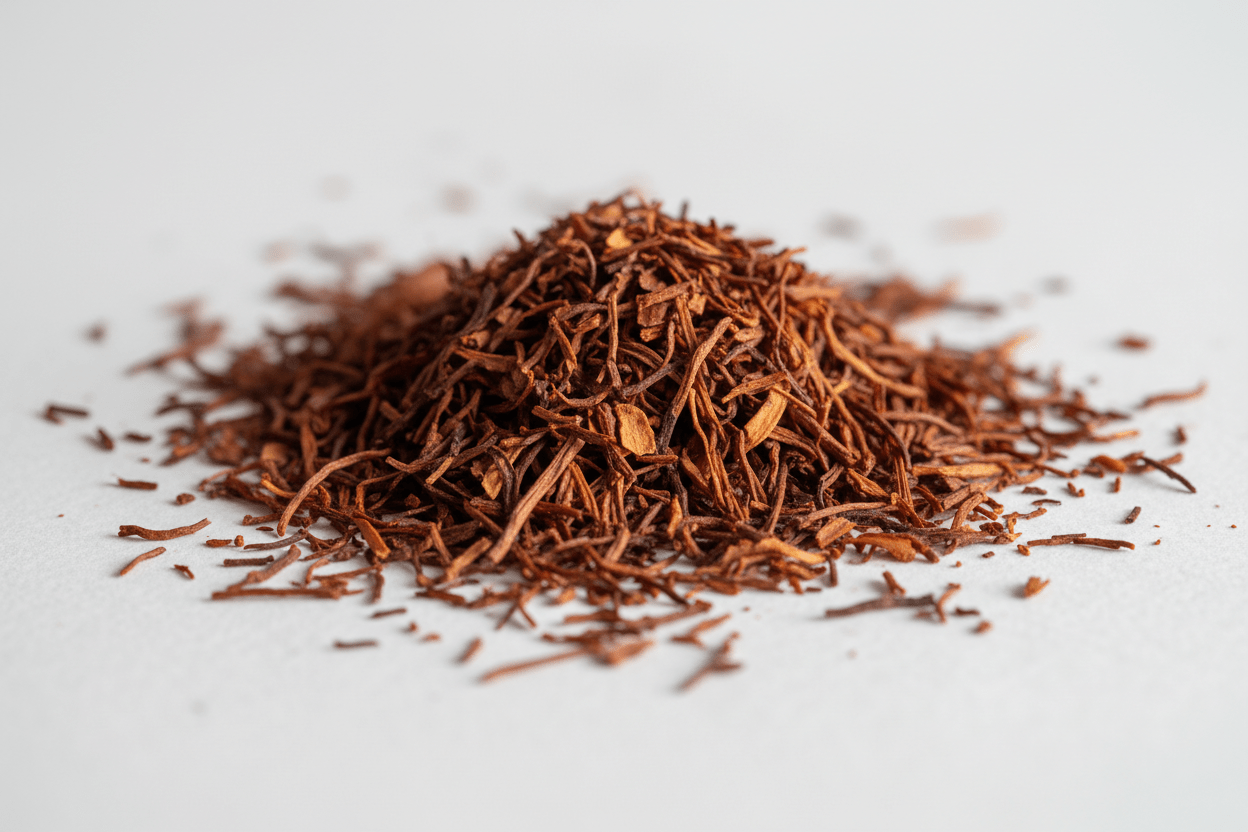
There's a plant that grows only in one place on earth.
It needs the specific acidity of fynbos soil, the sharp alternation of wet winters and dry summers, the particular slope of the Cederberg mountains. It isn't cultivated so much as it's coaxed. That plant is rooibos — and it's where two of our three blends begin.

The other one, honeybush, grows in the same general world: the fynbos biome of South Africa's Western and Eastern Cape. Different plant, different light, the same specific geography that makes it possible nowhere else.

We're a small tea company built around the idea that what you're reading and what you're drinking can inhabit the same slow hour. We thought a lot about what that tea should be. This is the story of how we found it.
Why South Africa?
It wasn't an aesthetic choice.
Rooibos (Aspalathus linearis) has geographic protection similar to Champagne or Parmesan: by law, it can only be called "rooibos" if it's grown in the Western Cape of South Africa. The soil, the altitude, the rainfall pattern — remove any of those and the plant either won't grow or won't produce the same needle-like leaves that make the tea what it is. There's no workaround.
Honeybush (Cyclopia species) works the same way. It's endemic to the fynbos, a biome recognized as one of the world's six floral kingdoms, covering roughly 90,000 square kilometers of the southern tip of Africa. Most of what grows there grows nowhere else. Both of our botanicals are among them.
So the answer to "why South Africa?" is: because that's where these plants are. We weren't looking for something exotic. We were looking for the right thing, grown in the only place it can be.
Our Supplier
We spent time on this before we ordered anything.
Our supplier, Metro Tea, offers us food-safe crop to cup tea. Through decades in the tea business, they’ve developed strong ties with growers and their families all over the world. This allows them and by exension marginnotes to buy teas during peak seasonal crop times, on tea estates known for quality, social equity, and environmental sustainability. Our three blends are grown by Cape Town-based producers with over a decade of history in the industry. When we ran a formal supplier evaluation — scoring against criteria including food safety, ethical labor standards, traceability, and documentation — Metro Tea came back with six active certifications and an 85 out of 100 on our own framework. That wasn't something we were expecting to find so cleanly.
The certifications matter because they're independently verified: ETP (Ethical Tea Partnership), FSSC22000 (food safety management), HALAL, KOSHER, and others. Not a list we assembled to look reassuring — a set of credentials that told us this was an operation that had been audited by people who weren't us.
We also asked about their supply chain documentation before we placed our first order. They sent it. That sounds like a low bar. It isn't, always.
The Three Blends
The sourcing story connects directly to what's in the pouches.
soft refrain is our rooibos evening blend — uncaffeinated, certified organic, from the Western Cape. If rooibos has a personality, soft refrain leans into its warmth without drama. The one that asks nothing more of you than to sit down.
by lamplight is also rooibos, also certified organic. The after-dark version — earthier, amber, made for the hour after everything else has stopped. If soft refrain is the afternoon, by lamplight is 10pm and a book you've been meaning to finish.
first light is honeybush, and it's different. Lighter, naturally sweet, with a gentleness that works well in the morning before you've decided what kind of day you're having. It comes from the same fynbos region, the same tradition of careful cultivation — just a different plant, a different rhythm.
What Ethical Sourcing Actually Looks Like
We built the supplier framework before we launched, not after.
That meant: certifications requested before the first order. A formal scorecard completed before we listed anything for sale. A Supplier Code of Conduct in draft. A sourcing decision that wasn't about optics — because there wasn't anything to be optics for yet.
We're also members of 1% for the Planet, which means 1% of our net revenue goes to environmental nonprofits. But that commitment came from the same place as the sourcing decision: the belief that you either build a business this way from the beginning, or you don't.

The Cape Floristic Region is one of the most biodiverse places on earth. It's also under pressure — from climate change, agriculture, invasive species. The plants we use are farmed, not wild-harvested, and our supplier operates under sustainability certifications. We're not claiming we've solved anything. We're saying we thought about it before we placed the first order.

The cup of tea in your hands started somewhere specific — a ridge in the Cederberg, a valley near Swellendam, a plant that doesn't grow anywhere else. We think knowing that changes the experience slightly. Not dramatically. Just enough to make the quiet feel earned.
Shop the blends: soft refrain · by lamplight · first light