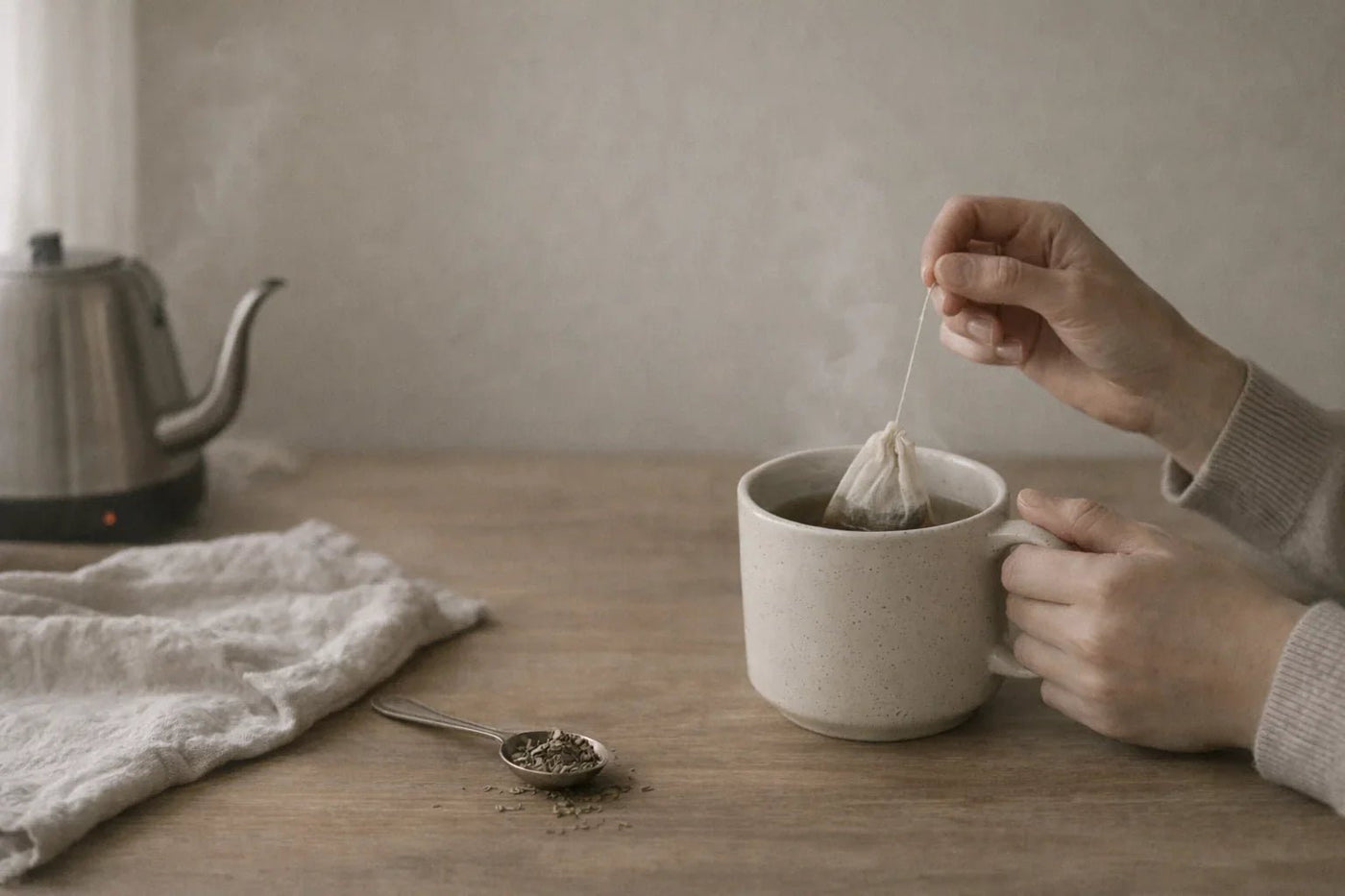
The kettle clicks on. A small sound, easy to miss.
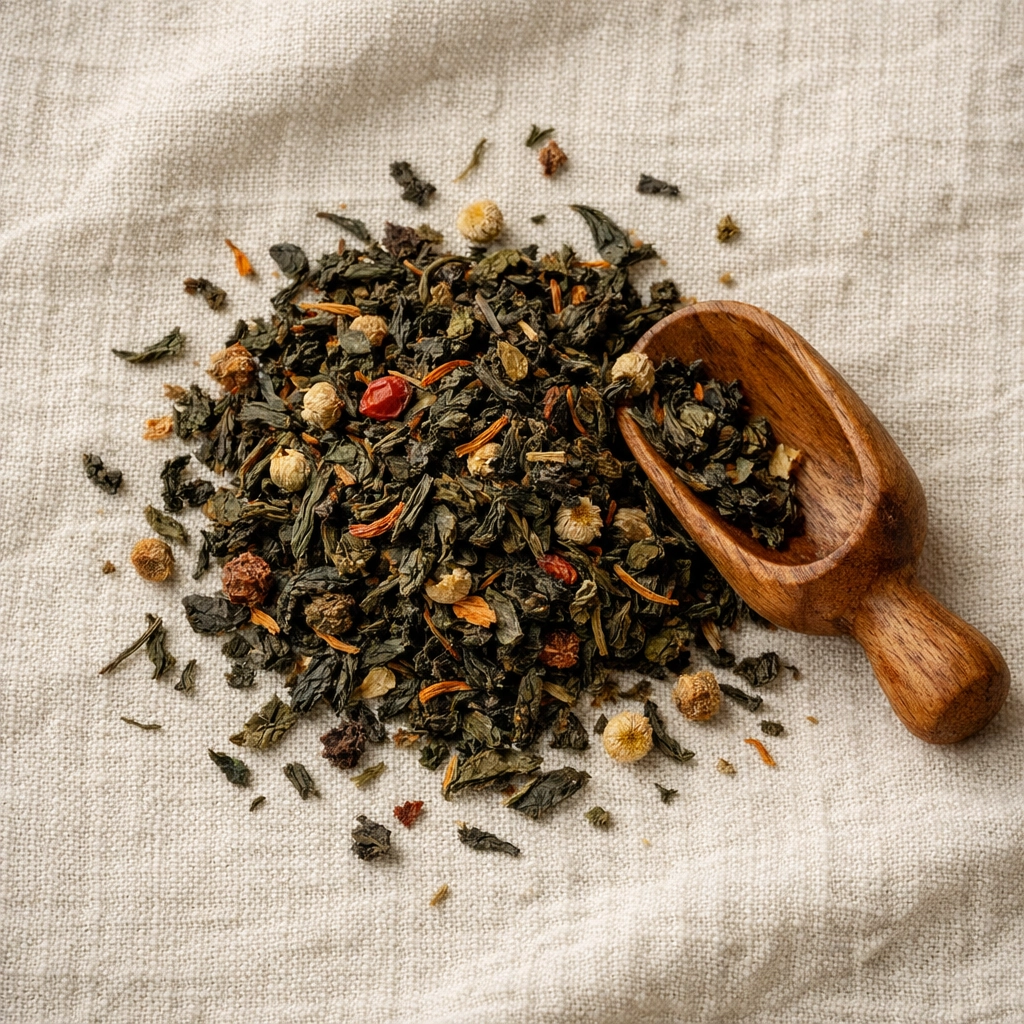
While the water warms, you scoop a pinch of leaves and watch them settle—dull at first, then faintly glossy where they catch the light. It’s ordinary. It’s grounding. It’s the kind of moment that makes room for a few quiet pages before the day starts asking things of you.
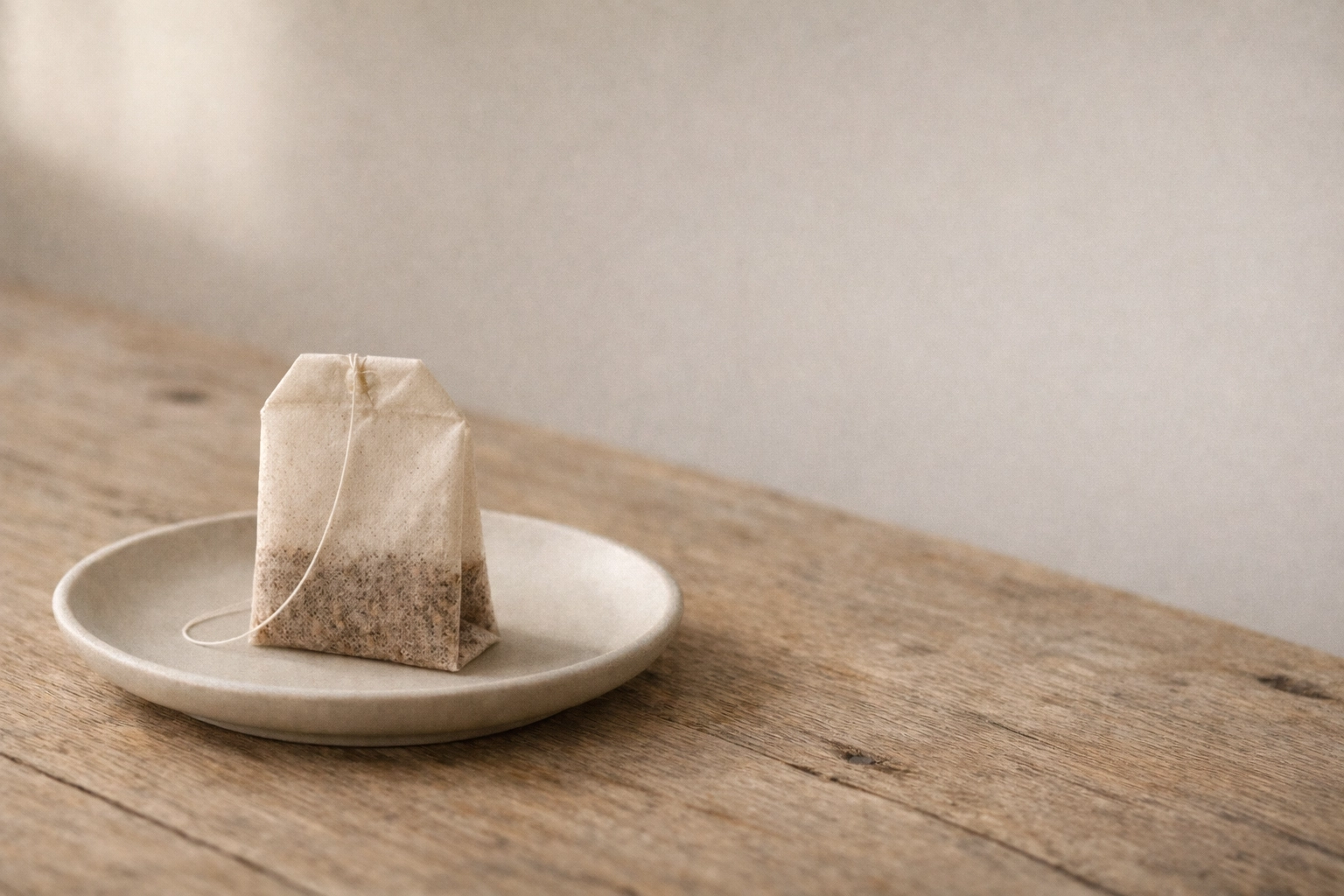
And then there’s the tea bag. Not the idea of it—just the material reality. What looks like paper is often something else, or something mixed. If you’re trying to keep the ritual simple, it’s worth knowing what’s doing the steeping with you.
The unseen guest in the cup
When we think of plastic pollution, we often envision discarded bottles in the ocean or synthetic fibers in our clothing. We rarely associate it with a warm, comforting mug of tea. However, research has revealed that the modern tea bag is often far from a simple paper pouch.
In 2019, a landmark study from McGill University found that a single plastic tea bag steeped at brewing temperature (95°C) released approximately 11.6 billion microplastics and 3.1 billion nanoplastics into a single cup of water. It’s worth noting that subsequent researchers have questioned the exact particle counts, though the core finding—that significant leaching occurs—has not been disputed. These numbers are difficult to visualize, but the reality is stark: frequent tea drinkers may be consuming billions of plastic particles every year.
https://pubs.acs.org/doi/abs/10.1021/acs.est.9b02540
Most commercial tea bags use plastics like nylon or polyethylene terephthalate (PET) for structure. And even many traditional “paper” tea bags aren’t quite what they look like. According to a Beyond Plastics fact sheet, polypropylene is commonly used as a sealing plastic in many tea bags marketed as paper, helping them hold together in hot water.
https://www.beyondplastics.org/fact-sheets/microplastics-in-tea
The rise of bio-plastics: a partial solution
As awareness of microplastics has grown, the industry has shifted toward “bio-based” materials. You’ll see PLA (polylactic acid) most often—marketed as plant-based, sometimes even compostable.
But “plant-based” doesn’t automatically mean “plastic-free,” and it doesn’t guarantee the material disappears in the places most of us can actually compost. Two things have become clearer in the last few years:
First, PLA tea bags can still shed very small particles. A 2023 paper in the Journal of Hazardous Materials examined the release of PLA nanoplastics from commercial tea bags and found they can be taken up by gut-derived cells in lab models, with a slight, short-term change in barrier integrity observed under certain conditions.
https://www.sciencedirect.com/science/article/pii/S0304389423011822
Second, “biodegradable” tea bags don’t reliably break down in soil. A 2024 study in Science of the Total Environment found that PLA-based tea bags—especially pure PLA—can persist under environmental conditions, with the cellulose portion of blends breaking down more readily than the PLA component. In other words: the part that’s still plastic tends to stick around.
None of this is meant to spark fear. It’s just the quiet inconvenience of mixed materials. If you want a clean, straightforward cup, the simplest answer is still the oldest one.
Why loose leaf remains the quietest choice
At marginnotes, we’ve always favored loose leaf. Not as a purity test. More as a way to make the ritual less complicated.
When you remove the bag, you remove the unknowns that come with it: the reinforcing fibers, the sealants, the coatings, the “compostable” asterisk. You’re left with leaf and water. That’s it.
Loose leaf also asks you to be present in a small, practical way. You see the leaves unfurl. You smell the first lift of steam. If you like to read while your tea steeps, it’s a natural pause—one page, then another, then the pour.
A simple glass or stainless infuser helps keep that simplicity intact. It pairs well with a tea that holds its shape—like By Lamplight, which was blended for slower evenings and the kind of reading light that doesn’t hurry you—and the whole thing stays quiet.
Crafting a microplastic-free tea reading ritual
For those of us who keep a book nearby, the process matters as much as the drink. Not because it needs to be elaborate, but because it gives you a clean break in the day.
If you’re moving away from tea bags, it can stay simple:
- Choose your vessel: Glass or stainless steel keeps the brew straightforward. Let the water move around the leaves. Let the leaves be visible.
- Select whole leaves: Look for tea that still looks like tea. Whole leaves tend to taste fuller and less sharp than the fine “dust” often used in bags.
- Mind the temperature: Water just off the boil is usually enough. It’s gentler on the tea, and it keeps the ritual calm.
The act of making tea is a series of small, intentional movements that bring us back to the present. Introducing plastic into that moment can be a kind of noise you didn’t ask for.
A circular way to drink
When we talk about “circularity,” we are talking about a system where nothing is wasted and everything has a place to return to. Loose leaf tea is a genuinely circular beverage. The leaves come from the earth, they provide us with a moment of clarity and nourishment, and then they return to the earth as compost.
By avoiding the “compostable plastic” trap, we avoid the ambiguity of industrial processing. As you settle into your next chapter—whether it’s a difficult non-fiction piece or a light, drifting novel—consider the water in your cup. Let it be as clear and as honest as the thoughts you find in the margins.

Further reading and sources
We try to be factual and restrained in our claims. If you want to read more, here are the sources referenced above:
- McGill University Study (2019): “Plastic Teabags Release Billions of Microparticles and Nanoparticles into Tea.” Environmental Science & Technology. https://pubs.acs.org/doi/abs/10.1021/acs.est.9b02540
- Journal of Hazardous Materials (2023): “The release of polylactic acid nanoplastics (PLA-NPLs) from commercial teabags.” (PLA nanoplastics release and interaction with gut cell models.) https://www.sciencedirect.com/science/article/pii/S0304389423011822
- Science of the Total Environment (2024): “Deterioration of bio-based polylactic acid plastic teabags under environmental conditions…” (Findings on persistence in soil; blends vs. pure PLA.) https://www.sciencedirect.com/science/article/pii/S004896972402953X
- Beyond Plastics Fact Sheet: “Microplastic Pollution in Tea.” (Notes on plastics used in tea bags, including polypropylene in many “paper” bags.) https://www.beyondplastics.org/fact-sheets/microplastics-in-tea
If you’re new to loose leaf and want a gentle place to start, our beginner's guide to loose leaf offers a quiet walkthrough of the process.
The transition to a microplastic-aware brew isn’t about perfection. It’s about keeping one small part of the day as clear as you can.
Written with care by marginnotes. We blend tea for the quiet moments and donate 50% of our net profits to clean water and environmental causes.